
I go to bed early. It’s a middle-age phenomenon I’ve reluctantly accepted I require, and suffer when I disregard. But once a year I join young Toronto (because really, the rest of us went to bed hours ago) to float from exhibit to gallery, to immersive art installation soundwave experience goo, and revel in all things irreverent, beautiful, garish, and astounding. Honestly, it feels great.
With my sample size of one, I’ve concluded that the popularity of Nuit Blanche, an all-night art extravaganza that literally brings art to the street, is because it feels so damn good. Walking down the centre of a car-less Dundas Street West, under the neon glow of Chinese apothecaries and noodle-ries, sends me spinning. Add in spectacles and think-pieces and crowds of locals and tourists and puppies and babies, and wow! I wouldn’t be surprised if there were a mini baby boom every nine months after this all-nighter. Being in communion with your neighbours can be hard to come by in Toronto, so I don’t blame anyone for getting a little mushy when it happens.
Nuit Blanche has been an October staple since launching in Toronto in 2006. Stylized after the Parisian festival of the same name, the Toronto iteration claims to be the largest all-night contemporary art event in North America, which sounds impressive until you learn it’s a pool of six.
I’ve been to Paris. Yes, the baguettes are that good, but no, it isn’t ground zero for all things stylish and arty and delicious. Paris’s Nuit Blanche debuted in 2002 and certainly helped popularize the format, but all-night arts festivals existed long before that. Helsinki’s Night of the Arts, for example, launched in 1989 as part of the Helsinki Festival and spills creativity into the streets in much the same way. Yet Paris gets the mythology while Finland remains… far away. The habit of elevating one origin story while sidelining others feels tired and familiar. Are we really still doing this?
Consider Toronto’s 2025 Nuit Blanche theme: Translating the City. Inspired by the city’s multicultural identity, it asked artists to explore how art can translate complexity, inviting us to consider where we fit in the urban landscape and what role we play within it. It’s clearly engineered to hit you right in the gut, and as much as I roll my eyes at that kind of earnest framing, it usually works.
As palpable and satisfying as the festival was, explicit representations of the theme weren’t always easy to spot in the thick of Chinatown and the downtown west areas I wandered through. But one installation stood out as being so on-theme it was practically a job application, in the best possible way.
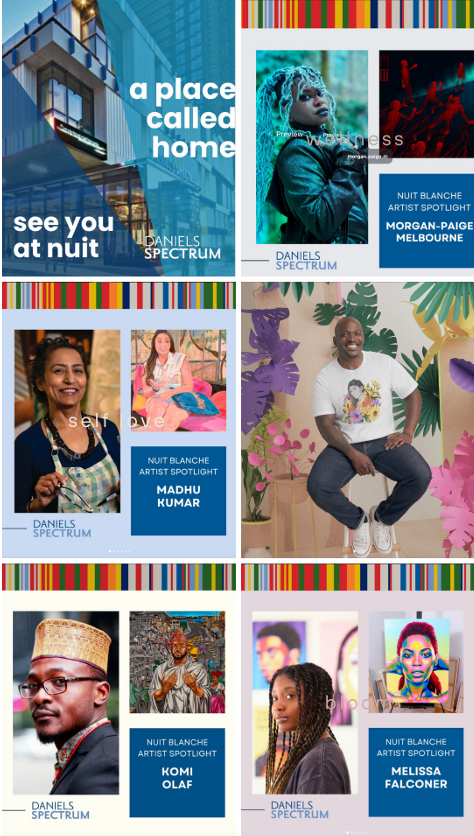
Created collaboratively by artists @morgan.paige.m, @bennybing, @melissafalconer, @komiolaf, and @madhukumar.art, A Place Called Home transformed Daniels Spectrum, a community and culture hub in the heart of the rebuilt Regent Park, into a multimedia immersive experience exploring empathy, sincerity, and collective growth in shared urban spaces. The work focused on Regent Park, a neighbourhood that has undergone dramatic transformation yet remains widely misunderstood or overlooked.
Drawing on migration stories and lived experiences, the artists used sound, projection, and visual storytelling to explore what it means to belong in a place that is constantly being rewritten. The installation did not attempt to present a single narrative of Regent Park. Instead, it layered voices and memories in a way that reflected the complexity of the community itself.
Suggesting Helsinki’s overlooked arts festival is a direct analogue for Regent Park is a stretch, but the broader dynamic- the amplification of some stories while others remain peripheral- connects them. Nuit Blanche showcases roughly 1,800 artists producing more than 6,000 works across the city, yet there’s an asymmetry in which stories are centered.
A Place Called Home stood out in part because of where it was located. Daniels Spectrum holds Major Institution status within Nuit Blanche, making it a festival hub rather than a peripheral venue. For Regent Park, a neighbourhood that previously appeared in the festival more as a rumble in 2024 and a whisper in 2014, this visibility matters.
Art cannot resolve the tensions created by redevelopment, nor can a single installation capture the full identity of a community. But projects like A Place Called Home demonstrate how art can create space for recognition. In a festival dedicated to translating the city, the work offered something simple yet powerful: a chance for Regent Park to speak in its own voice.
Our team has connected with each of the artists to better understand why they created these works, what it means for Regent Park, and the Downtown East community more broadly.
Stay tuned as we continue to explore the intersection of art and identity in Regent Park. To whet your appetite, here’s a sample of Morgan-Paige’s creativity:
And because our Finnish neighbours deserve to be witnessed too, please enjoy this instructional video about how to open a door:
The team members of Store-ies are Eryn McDevitt, Andrea Jakaitis and Caitlin Devion.