
I will stay up through the morning, I'll be on my knees
My God, I can't sleep without you guiding my dreams
I can't draw you, I can't paint you, my eyes are weak
Tell me what to think, tell me what to see
I'll go anywhere to bring you closer to me
I'll go anywhere, I'll go anywhere
I'll go anywhere to bring you closer to me
I'll go anywhere, I'll go anywhere
- Mustafa the Poet, I’ll go Anywhere
Last week, our group sat down to review and further develop our interview questions. We were off to a great start, but our questions weren’t quite there yet. For our group in particular, each one of us were a bit worried that “Faith and Displacement” might not be a relevant enough topic that the volunteers and faith leaders at Masjid Omar Bin Khatab have dealt with. In the case that our interviewees may not have an answer to our questions, we were prepared to pivot our topic based on other challenges related to Regent Park they would note. With the help of Professor Mehta, we were able to use her feedback to strengthen our questions and prepare for the interview on Sunday.
Conducting interviews is often perceived as a simple task, but researchers have found that they are actually very hard to do well (Cairns-Lee et al., 2022). In fact, interviewing is not just the employment of the everyday skills of conversation, but are complex discussions involving impression management, meaning-making, and the application of cultural scripts, with interviewers acting as an asset to the trajectory of the depth of discussion findings (Cairns-Lee et al., 2022). In an attempt to minimize distorting effects on research findings, a researcher should continuously take reflexivity into account, reflecting on the ways in which they have influenced the outcome of interview findings (Cairns-Lee etal., 2022).
Nashat knew the participant through a mutual contact. Before the interview, Nashat explained the project on a phone call, built rapport, and sent the questions in advance. As a result, the participant felt comfortable sharing her perspective. Belonging to the same faith group, there was a point at which Nashat felt as if the interviewee may have been speaking a bit too general about faith rather than providing specific examples from the Islamic paradigm, which we think was due to her understanding that we wanted to capture interfaith perspectives. With a simple nudge indicating that it would be okay for her to be a bit more personal with her answers, the findings became even more meaningful and interesting!
The interview turned out to be a great success! Tracy helped with setting up the camera, recording, and monitoring the audio and video while Nashat and Sama took turns asking the interviewee questions. The semi-structured interview went smoothly; Nashat and Sama were so invested that more questions outside of the initial questions were being asked. The interviewee gave us a lot of information and knowledge about Masjid Omar Bin Khatab, displacement in the community, and her role at the mosque as well.
One of the very insightful findings we were able to uncover in the interview was the fact that amidst displacement there was a notable shift in mosque attendees. While some tenants continued to attend Masjid Omar bin Khatab even after being displaced, others were forced to find new places of worship in the community such as Masjid Toronto (Dundas and Adelaide locations) which is a prominent mosque in Downtown Toronto connecting to the broader theme of the Downtown East identity. For some, however, the displacement meant the complete erosion of the community they built.
The interview came to a close with the interviewee gifting each of us an adorable purple handmade set of prayer beads with a message, “Dhikr (remembrance of God) will be a nur (light) for you in your grave, and on the Day of Judgement. This nur will keep you steady on the sirat (a bridge which must be passed on the Day of Judgment) that will guide you to Paradise”. Thus came a sweet close and a smoothly sailing start to our documentary.
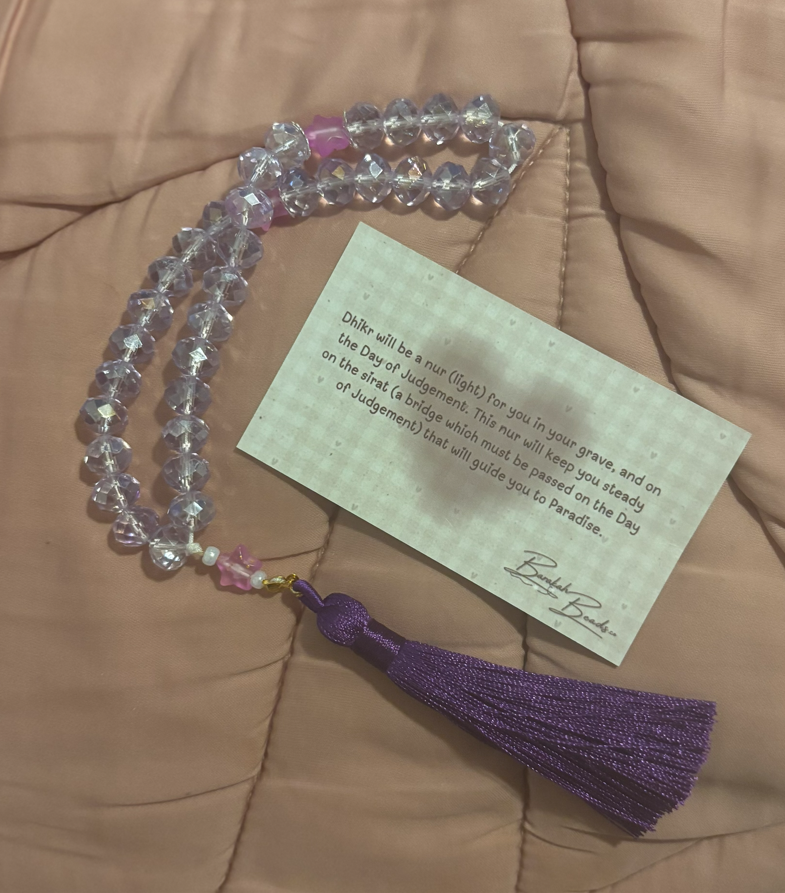
Image of prayer bead gift
There is still so much we would like to uncover as there were a few questions that our interviewee felt would be best suited for the Imams and regular attendees at the Mosque. Stay tuned for next week while we begin editing the documentary and continue conducting interviews with Regent Park residents and a few Imams at Masjid Omar bin Khatab! In the meantime, please see this vlog showcasing short clips from the day of the interview!
The team members of Resilience and Faith are Tracy Ikpekhia, Sama Abbas and Nashat Nawar.