
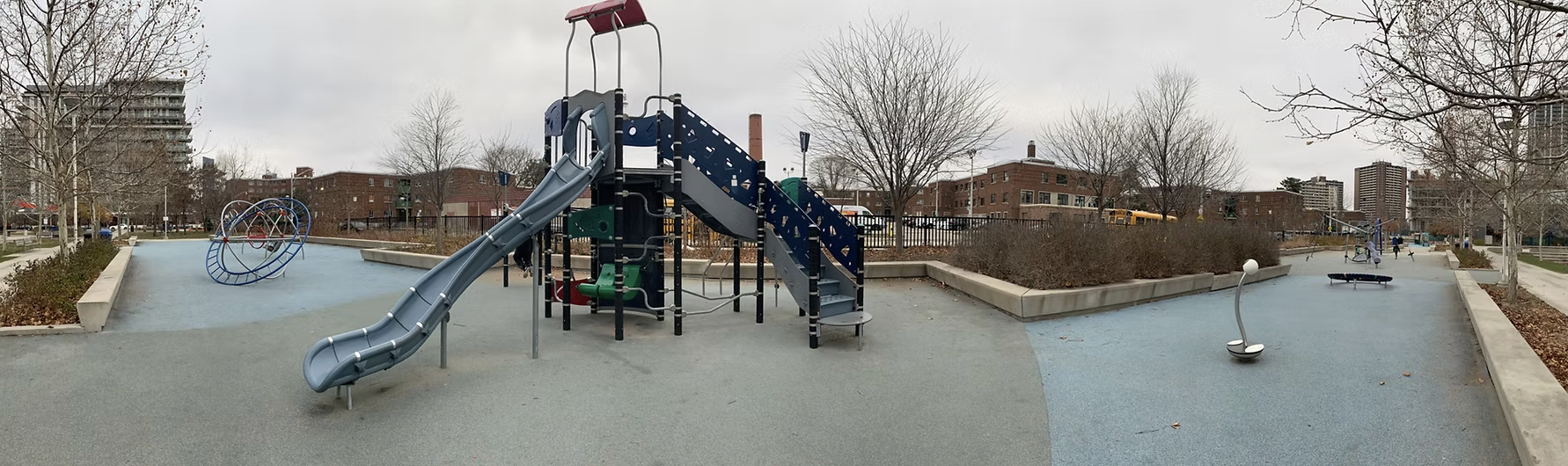
This week, our group began conducting preliminary research to further understand the neighbourhood issue. During our group discussion, we realized that we did not want to imply that the neighbourhood is dangerous, as historically, Regent Park has been associated with poverty and crime in Toronto by media outlets.
As the large-scale redevelopment projects have significantly transformed the neighbourhood’s landscape and population, our interviews should focus more on the perceptions of the everyday experiences families have. To support this, we plan to look up crime statistics, media healthlines, historical accounts of Regent Park’s redevelopment, and potentially attend the safety meetings held by the Regent Park Social Development Plan (RDSDP), as mentioned by Adonis.
As of now, our research question remains the same: how do parents and children in Regent Park (or the downtown east) differ in their perceptions of safety and navigation within the neighbourhood, and what does this reveal about the downtown east identity? Again, we wish to have the question not sound as opinionated or targeted, and want to know people’s perspectives at first glance or experience here.
Our project will take the form of a short-form, interview-driven documentary. It will primarily feature interviews with parents, while also (hopefully) incorporating perspectives from their children when it is appropriate and ethical. Alongside these interviews, we will add other visual footage of the neighbourhood, such as parks, streets, playgrounds, or community spaces. We feel that keeping the documentary interview-heavy will center the perspectives of the residents we choose to interview, and that it will keep our research on the right track.
Moving forward, our production plan will be focused on transcribing these conceptual goals into a tangible piece of media. We will collect data by navigating demographic data to see how the neighbourhood’s safety profile has shifted since the redevelopment. Additionally, we discussed attending the next RPSDP Safety Working Group meeting to listen to current residents and their concerns to help us refine our interview scripts.
As our project will be interview-heavy, our primary goal is to secure a solid group of voices. We are prioritizing identifying families who have lived in Regent Park through different stages of redevelopment to capture an in-depth perception of the change. When interviewing children, we have decided to keep them off-camera or use creative framing (such as filming their toys or their parents) to protect their privacy while ensuring their voices are central to the narrative.
To avoid any technical issues during production, we have established a plan where we will not use a single device for both audio and video. As advised by the production team at FOCUS, we will use at least two devices, one to document and the other as a mic for a higher-quality audio.
Regarding our filming locations, we are debating between the intimacy of home-based interviews and the visual of Daniels Spectrum. We would like to capture film of everyday life in the downtown east area, as tools to cement our research question within the neighbourhood and community.
In moving forward with this project, it is essential that the voices of community members remain at the center of our work. Rather than relying solely on statistics or outside interpretations, listening to the everyday experiences of families in Regent Park allows for a more nuanced understanding of how people actually live, move through, and relate to the neighbourhood. We want this documentary to center residents’ own knowledge of their community, which ensures that conversations about Regent Park are shaped by the people who live there.
The team members of Yellow Brick Road are Lexie Young, Renee Chiu, Alpha Vu, Makita Depradine and Ali Joya.