Interviews DONE!

In Week 11, our group made major progress on our project. We continued to conduct background research on our documentary subject, allocated weekly tasks, and completed our final interviews. During half of our class time, Maddy and I interviewed long-time Regent Park volunteer hockey coach and community advocate, Jim Stoner, who brought along a number of friends and fellow community members along for the ride. During the second half, Mishika and Summayahh arrived and we got to work on allocating tasks for the week and workshopping a timeline for the remainder of our documentary.  

It was just past 4PM on Thursday, Maddy and I met up with Jim, his two friends Debra and Phil, and former student, Liam. Before the interview, we got into lengthy conversations about each of their experiences in Regent Park; then, however, we started to realize a lot of our conversations were very valuable to our project, and that we should start recording… 

Jim, Debra, Phil, and Liam, provided many (many!) stories about their time at the rink. They talked about their favourite memories, the programs Jim ran over the years, how the changes in the neighbourhoods has shifted how the rink is used, and what the future of the rink looks like - especially in regard to Jim’s journey to attaining a roof for the Rink! If I tried to detail everything Jim and co. said, this blog post would be 50 pages long. To summarize, however, our very rich discussion focused on the meaning and strength of the community in Regent Park and what accessible public spaces and programs mean to a historically lower-income, immigrant neighbour like RP. It also homed in on what the Rink’s Canadian-ness means to a multicultural, immigrant neighbourhood like Regent Park, our major research focus.  

After our interviews with Jim and friends, a woman bicycled up to the rink and asked if any of us worked there (in hopes of using the washroom). We then got to talking, and Jim introduced himself. It turns out, the woman was a long time east ender, who spent much of her life skating at Regent Park with her brothers - and Jim had coached them! She was stunned with how much the neighbourhood had changed, and started to tear up about how special this moment was. We then decided to interview her. It was a moment that was emblematic of the true importance of community; she began to name her close friends and family who grew up in Regent and the east-end, and Jim recognized everyone. She declared that she would organize her friends and family to come to the yearly hockey tournament Jim was organizing, and made sure to help on his commitment to attaining a roof for the rink. It was truly a special moment.  

After a very long interview period, we met back up with our group members and allocated tasks. We downloaded all of our interview audio and made an editing schedule. For the remainder of class, we did pretty autonomous tasks - sorting through the audio and doing independent research. 

All in all, our research question has stayed quite consistent, with our final question being: homing in on the fact that ice skating is a particularly “Canadian” concept, and the demographics of Regent Park residents are predominantly immigrants who may not have skated in their home countries/countries of origin, how does the notion of neighbourhood or community identity (de)construct in regards to “the Rink”? We are arguing that a new kind of identity forms, one that is uniquely tied to Canadian-ness, while simultaneously embracing the multi-cultural nature of Regent Park and Toronto as a whole and the low-income position of many in Regent Park. Talking to Jim, he did discuss how this has shifted with the revitalization. Many who attended his hockey programs had financial constraints to participating in the sport (one that is historically very expensive). Given this, we also want to underlay our documentary and paper with what it means to have accessible public services in predominantly immigrant neighbourhoods like Regent Park, what this means to community vitality, and how this can help maintain a sense of community amongst RP’s ever changing demographics. The goal of our documentary is to reveal what a long-time community hub means to a neighbourhood, especially one that is grounded in an intense national Canadian identity like an ice rink.  

As of now, we do not have an official outline. However, this will be developed in the following days in tandem with the end of our preliminary sound and video editing process. I have attached some interviews and B-Roll we shot this week as our media pieces.  

The team members of Frozen in Time are Mishika Khurana, Maddie Wintermute, Sumayyah Shahajan, and Charlotte Pink.
Frozen in…Interviews?!

This week was a pivotal one for our project, as we all started to realize just how much time was ticking and just how little time we had left for our project! With some support from Aditi, Adonis, and the FOCUS staff, we were able to streamline what needed to get done and get some support in acquiring interview contacts, while also continuing our ongoing research and archival documentation around ice rinks and Canadian identity. 

First, talking with Aditi helped us to create an action plan for interviews and a backup plan if the interviews didn’t pan out as we’d hoped. It was a good opportunity to practice adaptability and flexibility in regards to our project, and to envision how other aspects of our project, like archival photos, voiceover narration, and stitching stories together, might help us communicate our idea should we not get access to the exact interviews we want. Luckily, Tyrone and Adonis both helped connect us to some community members, including a local hockey coach and an original Regent Park resident who has used the skating rink for decades, and we are hoping to interview both of them this coming week! Then, over the weekend, Sumayyah and Mishika successfully conducted our first two interviews and scheduled a few more for this coming week. Overall, we are feeling like we are in much better shape! Interview footage from their wonderful conversations have been uploaded as our media component for the week. 

Beyond interviews, Charlotte and Maddy have been continuing to do research around ice rinks, looking at their intersections with both urban planning and with Canadian identity. As a result, the focus of our main research question has shifted a bit. Initially, we were looking at how youth/elders in the community viewed the rink differently across generations. Now, given our interview subjects and the supplementary research we’ve been able to access, we are focusing more on how the notion of neighbourhood or community identity is (de)constructed in regards to the rink, given that ice skating is a particularly ‘Canadian’ concept, and the demographics of Regent Park residents are predominantly immigrants who may not have skated in their home countries/countries of origin. 

Some particularly interesting tidbits from this research include a TMU graduate student’s capstone paper on urban planning for ‘winter cities’ – a movement founded by architects, designers, municipal planners, and urbanists in the 1980s to encourage better use of public space throughout the winter season. It presents an interesting tension between projects that have made outdoor space more palatable in the winter, like public art and street fairs, versus projects that have sought to “control the environment during the cold season”. As an example of the latter, it discusses the construction of the Eaton Centre, a large mall within walking distance of Regent Park, wherein its main architect Eberhard Zeidler stated that he considered the project a huge success because it created a “thermally neutral environment” in no way connected or related to outdoor space, where citygoers could escape the winter. This brings up interesting questions about the importance of outdoor public spaces, as well as their relationship to retail foot traffic, street safety or ‘eyes on the street’, and overall how we engage with and value different kinds of public space. While not all of these questions or concepts are going to be within the scope of our project, it was very interesting to gather background information to engage with our project through a more theoretical or academic lens, and we hope to include some of this information in our final paper, even if it doesn’t make it directly into our documentary. 

The team members of Frozen in Time are Mishika Khurana, Maddie Wintermute, Sumayyah Shahajan, and Charlotte Pink.
B Roll Shoot!

In Week 9, our group made headway on several tasks, including: working on a comprehensive spatial analysis, finalizing interview questions, teasing out our goals for the article and documentary, and, most importantly, shooting B-Roll footage! After designating tasks last week, our group members came together in class to showcase and discuss what we had accomplished.  

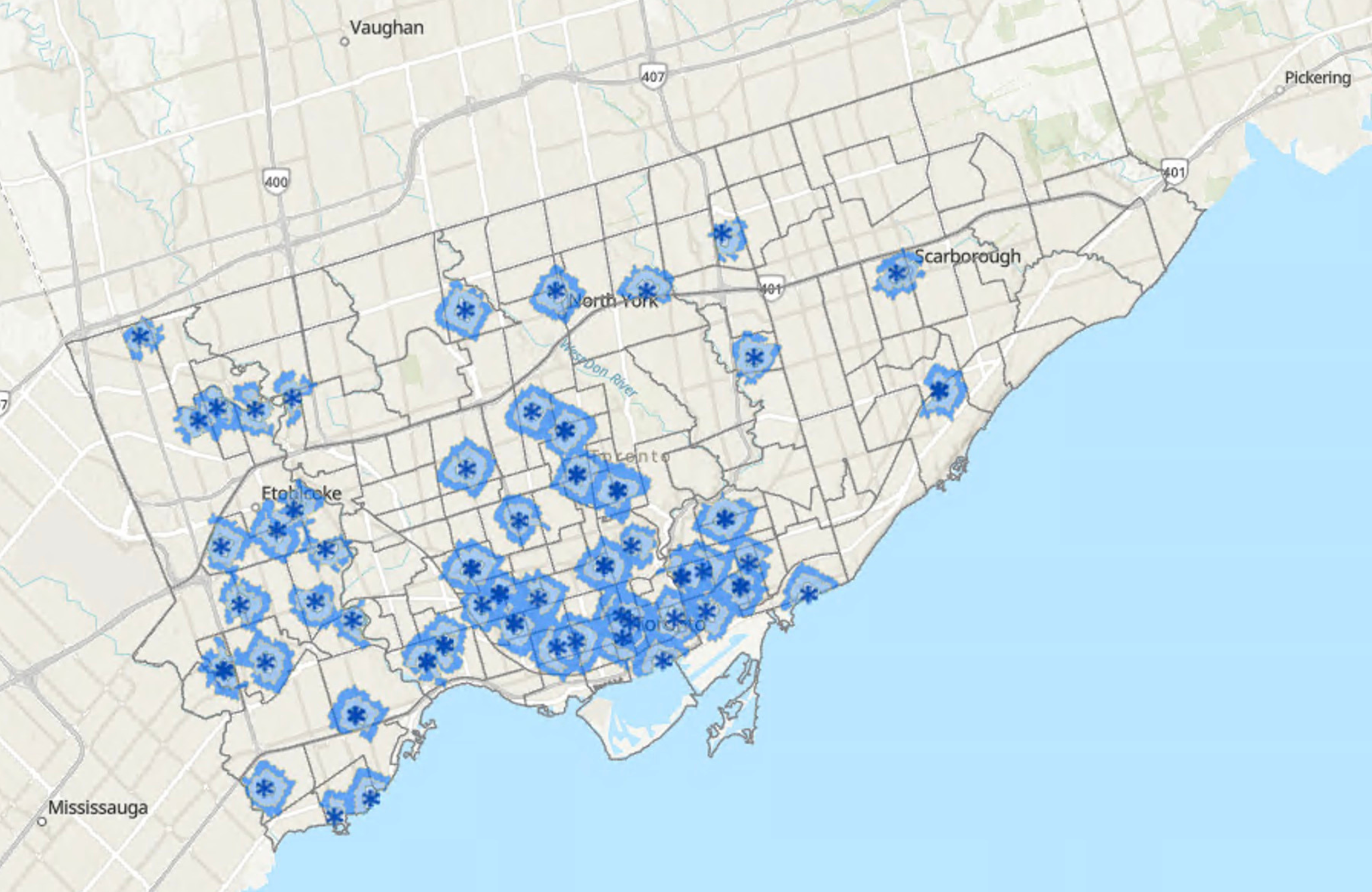
First, Mishika showcased her meticulously crafted network analysis that demonstrates pedestrian-friendly radiuses around outdoor rinks in Downtown Toronto. According to literature on pedestrian-friendly cities (World Health Organization, 2017; Crowley, D. F., Shalaby, A. S., & Zarei, H., 2009), we have determined that a 15-minute walk is what is considered a “pedestrian-friendly” distance. This work helps to substantiate that our rink serves the entire community of Regent Park, while other rinks, such as Riverdale, do not serve the community or only does partially. Access to Riverdale is also constrained by the Don Valley Parkway (DVP) which acts as a de facto border between Regent Park and Riverdale. Lastly, although Moss Park is within a 15-minute walk of South Regent, it: a). Does not serve most of the community, b). Is an indoor rink, and c). Only has 4 hours of open free skate a week, whereas Regent has around 5 hours a day!  

Next, we finalized our interview questions. Charlotte and Sumayyah collaborated on these questions, ensuring that they were straight forward, while being broad enough so that the interviewee feels comfortable to give us a thoughtful response. We settled on around a dozen questions, many accompanied by sub-questions, to carry out successful semi-structured interviews. We do not expect to get through all these questions in each of our interviews, as we want the interviewee to be able to somewhat guide the interview depending on the stories and experiences they wish to share. From here, we designated several interviewees we wanted to reach out to, and Sumayyah and Mishika edited their email template to send out in preparation to schedule interviews (hopefully) before next week's class! 

Last was our favourite part of the week, shooting B-Roll footage. Charlotte, Maddy, and Sumayyah met at The Rink at around 12 to take part in their afternoon free skate. It was only us and one other woman. As we told her we were filming and asked her if she would be comfortable potentially being in the background, she thought we were professional skaters. Unfortunately, none of us were, although Charlotte (the subject of many of our clips) did skate in her childhood. So, when the woman had questions about how tight her skates should be, she could offer some semi-professional advice. Then, Charlotte skated around the rink, and we got some solid shots. Another person eventually joined free skate, but this Thursday afternoon during school/working hours was not incredibly busy.  

We then made the trek over to Moss Park to see how it was being utilized and collect more B-Roll footage to include in our doc. We made it just in time for free skate to begin, and watched a much larger number of skaters enter the rink. We took some interior/exterior shots, observed some of the skaters, and then parted ways. Later that day, we brought out footage to class and organized it into a Google Drive folder. We aim to organize some of the shots by next week to home in on key footage (but do not want to omit too much B-Roll depending on the content of our interviews!).  

Underlying all this work, we outlined our goals for the article and documentary. This documentary and accompanying article will illuminate an often-overlooked public space and its essential role in serving the community in which it’s located. We hope to bring forward voices of community members that have grown up with The Rink, to provide varying perspectives on its position in their lives, and what it represents in an ever-changing Regent Park. We also want to use these pieces to highlight residents' experiences in an accessible and tasteful manner, so we hope to spend significant time on our editing process.  

This week, we hope to have scheduled and completed at least half of our interviews and start to become more familiar with the filming and editing tools in preparation for putting our final project together. For this blog post, I have included a screenshot of Mishika’s spatial analysis work, as well as attached some of our favourite B-Roll clips! 

Works Cited: 

Crowley, D. F., Shalaby, A. S., & Zarei, H. (2009). Access walking distance, transit use, and transit-oriented development in North York City Center, Toronto, Canada. Transportation Research Record: Journal of the Transportation Research Board, 2110(1), 96–105. https://doi.org/10.3141/2110-12 

World Health Organization. (2017). Urban green space interventions and health: A review of impacts and effectiveness. Full report. World Health Organization. https://cdn.who.int/media/docs/librariesprovider2/euro-health-topics/environment/urban-green-space-intervention.pdf 

The team members of Frozen in Time are Mishika Khurana, Maddie Wintermute, Sumayyah Shahajan, and Charlotte Pink.
Skating Through the Archives

This week’s working session focused on clarifying our research objectives, developing a plan of action for our documentary, and delegating roles to team members. Thinking through our idea of focusing on the Regent Park South Ice Rink, we adapted our primary research question to feedback we received, simplifying it to get to the heart of what we are trying to document: 1) How is “The Rink” understood by different generations of Regent Park residents? 2) What does it represent or preserve about Regent Park’s history in the face of rapid change? 

The first thing we discussed was how the rink fits into a broader narrative about the Downtown East. Although our initial finding that it was the only rink in the DTES was incorrect (which Adonis was very quick to call us out for!), it is true that it’s the only outdoor rink within a 20 minute walk of Regent Park, and this is the off point from which we’ll  start our discussion. The Moss Park rink is inside, which has a totally different building typology and spurs very different social relationships than an outdoor gathering place does. And while South Riverdale does have an outdoor rink, Mishika explained that even though it was often used for class field trips growing up, it isn’t a neighbourhood watering hole in the same way nor is it specifically by and for the Regent Park community. Additionally, the Don Valley Parkway is seen to some as a boundary of the DTES, so it’s not very accessible by foot to those in the neighbourhood. We decided we will get some footage of these rinks to offer a brief narrative overview of how they both relate to the DTES and create a network of public outdoor spaces, but then zoom back in on the particular role that the Regent Park rink plays in this ecosystem. 

We also discussed in more detail what our visual and aesthetic inspirations are for the documentary. We would like to combine various materials, like video footage, maps, archival photos, voiceover narration, and photos that we’ve taken, to stitch together a narrative that is full of colour and texture. We want the feel of it to be warm and lived in, and to have our own contributions as well as those of our interview participants feel candid and not overly formal. We discussed documentaries that we really love which achieve this; in particular, Charlotte mentioned Bill’s Tacos, and Maddy mentioned the NFB documentary Our Street Was Paved With Gold by Albert Kish, a favourite of hers. A throughline of these films is the focus on depth, not breadth, of specific subjects and places to weave a story. 

Lastly, we discussed how to divide up roles. Maddy will be doing research on urban planning and ice rinks, trying to understand the cultural and geographic history and significance of city ice rinks, as well as how the Regent Park ice rink was formed and what its initial operations looked like. Charlotte will write interview questions to be approved by Aditi, while Mishika will confirm interview subjects and begin scheduling interviews. She will also complete a few simple spatial analyses to compare photos of Regent Park versus other city neighbourhoods and their access to walkable rinks. 

Our next step will be meeting tomorrow (Monday morning) at the Regent Park rink to gather some initial shots of it in action. Although this early spring arrival has been a delight, it is also our principal concern right now: will everything have melted?! We realized we’re in a time crunch to gather this footage before winter slips away, so our main focus right now is on collecting all of the imagery we actually need from the rink in the nick of time. We are never ones to hope for a prolonged season of cold, but we do hope it hangs on just for another week while we meet our deadlines! 

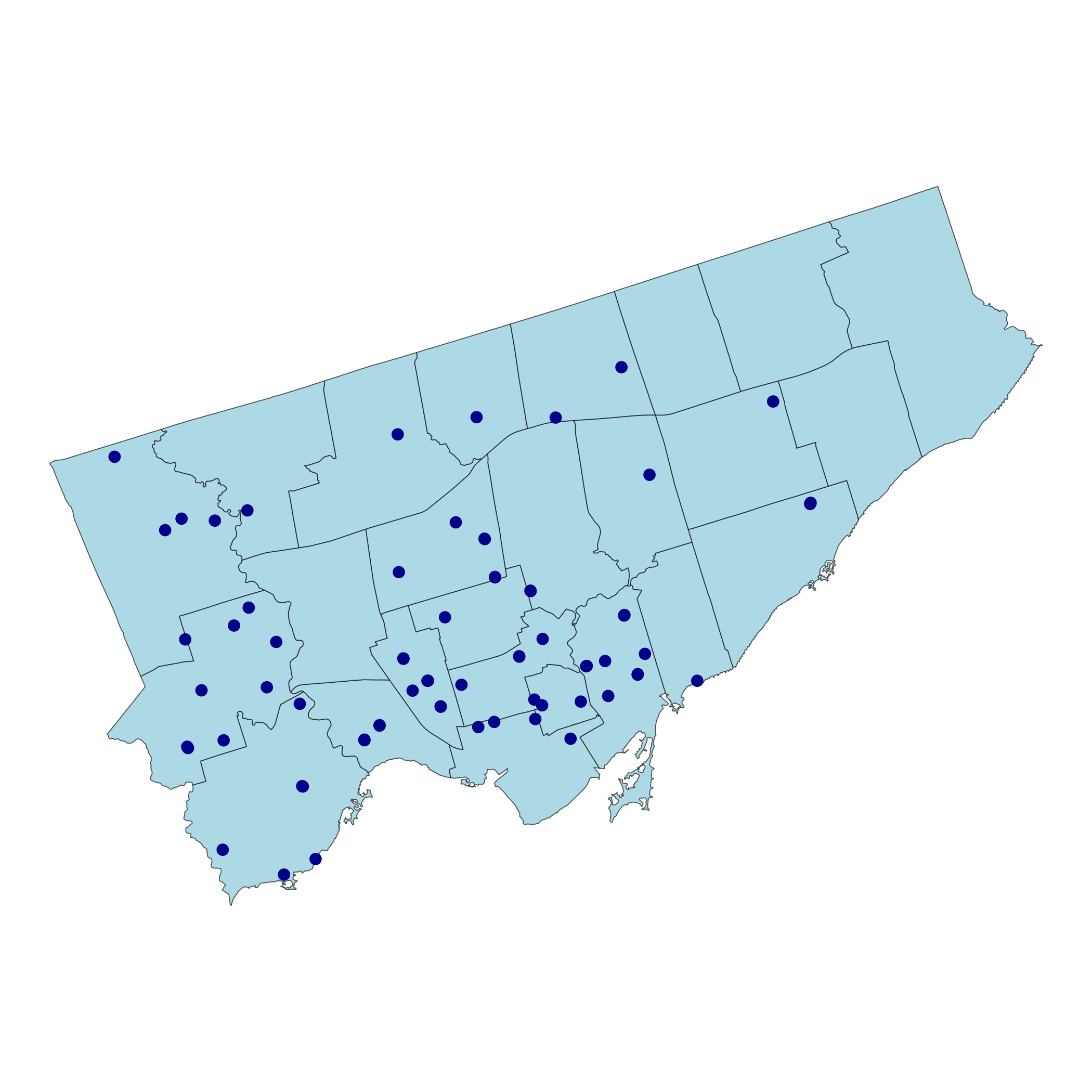
Attached for our media components is a quick map we made of ice rinks across the City, as well as a YouTube link to a video that Regent Park TV posted of the Friends of Regent Park community celebrating Family Day Skate in 2024 –  a testament to the core of our documentary that the ice rink brings spirit and togetherness for the community. 

Outdoor Ice Rinks Across Toronto By Ward (by Maddie Wintermute)

The team members of Frozen in Time are Mishika Khurana, Maddie Wintermute, Sumayyah Shahajan, and Charlotte Pink.
Frozen in Time

In Week 7, our group focused on identifying our central neighbourhood issue, teasing out the structure of our project, creating a team name, developing our key research questions, and assigning goals for next week. First, our team discussed how to mold our broader interests and ideas into a more narrow and feasible project idea. We begin our discussion wanting to focus our project on two main groups: elders who have been Regent Park long-time residents, and Regent Park youth. We planned on asking them about their favourite places, comparing the answers of the two groups, juxtaposing these with old archival footage of old Regent Park, and then mapping these answers onto a contemporary Regent Park map. However, we decided this approach may have had too many moving parts. Instead, we came together and thought: what if we just focused on one place in Regent Park, and went in-depth to understand what that place means to both younger and older generations? 

Mishika offered the idea of focusing on Regent Park South Ice Rink - or, “The Rink.” Its use has remained the same throughout the revitalization, whilst every other building around it has changed. We thought it would be fascinating to talk to folks about their memories of the rink and what its preservation means to them amid a neighbourhood facing constant change. Our choice to focus on one key spot was also influenced by the short doc, Bill’s Tacos, shown in our seminar. We hope to draw inspiration from this doc's use of interviews, B-Roll of the restaurant “happenings” (in our case, the neighbourhood and the rink), archival photographs/videos, and overall layered, short-form style. After having our big moment of clarity, we returned to choosing our group name - appropriately titling ourselves “Frozen in Time.” 

For our last task, we discussed our guiding research questions for our project. 1) How does “the rink” represent the resilience of the old Regent Park in the face of immense change? How is memory preserved in physical space? And 2) How is a culturally and historically significant public space, like Regent Park’s skating rink, understood and experienced by younger generations of residents amid the revitalization? Finally, we noted some tasks for next week's class: Maddy and I will be looking through city archives and other documentaries for inspiration, and Mishika and Sumayyah will be thinking about who we should reach out to for our interviews.  

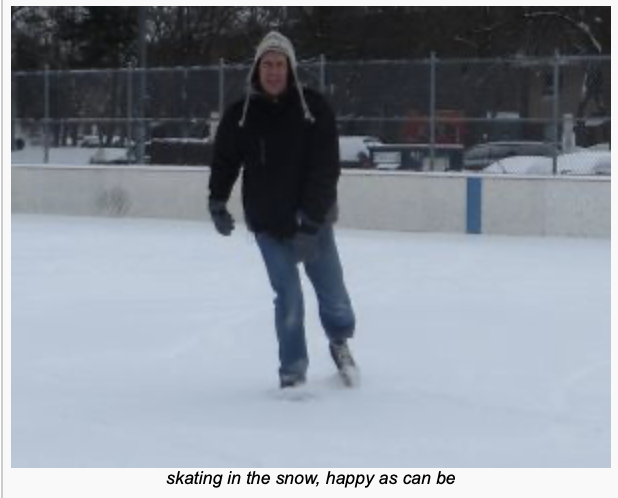
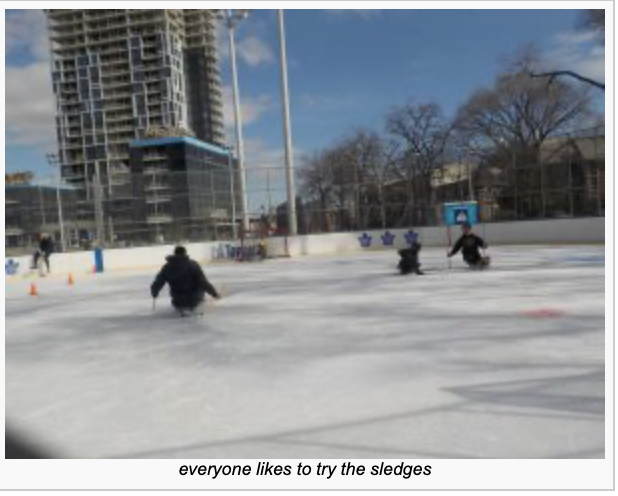
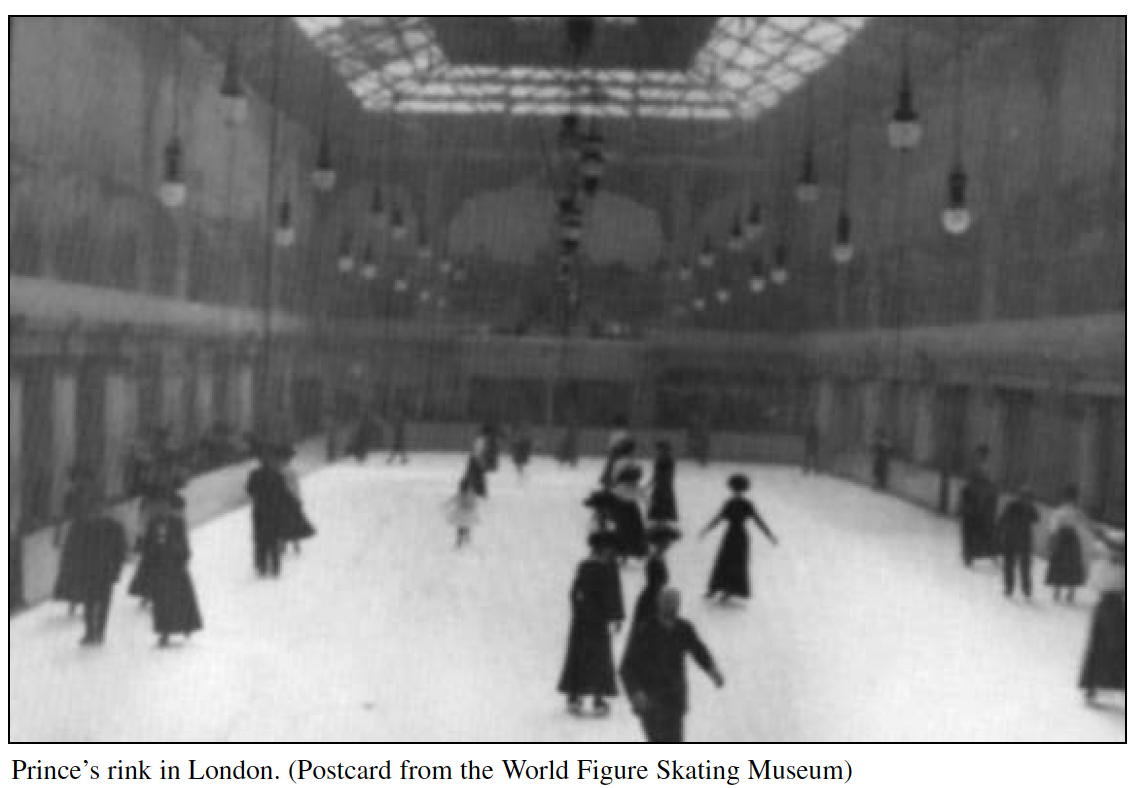
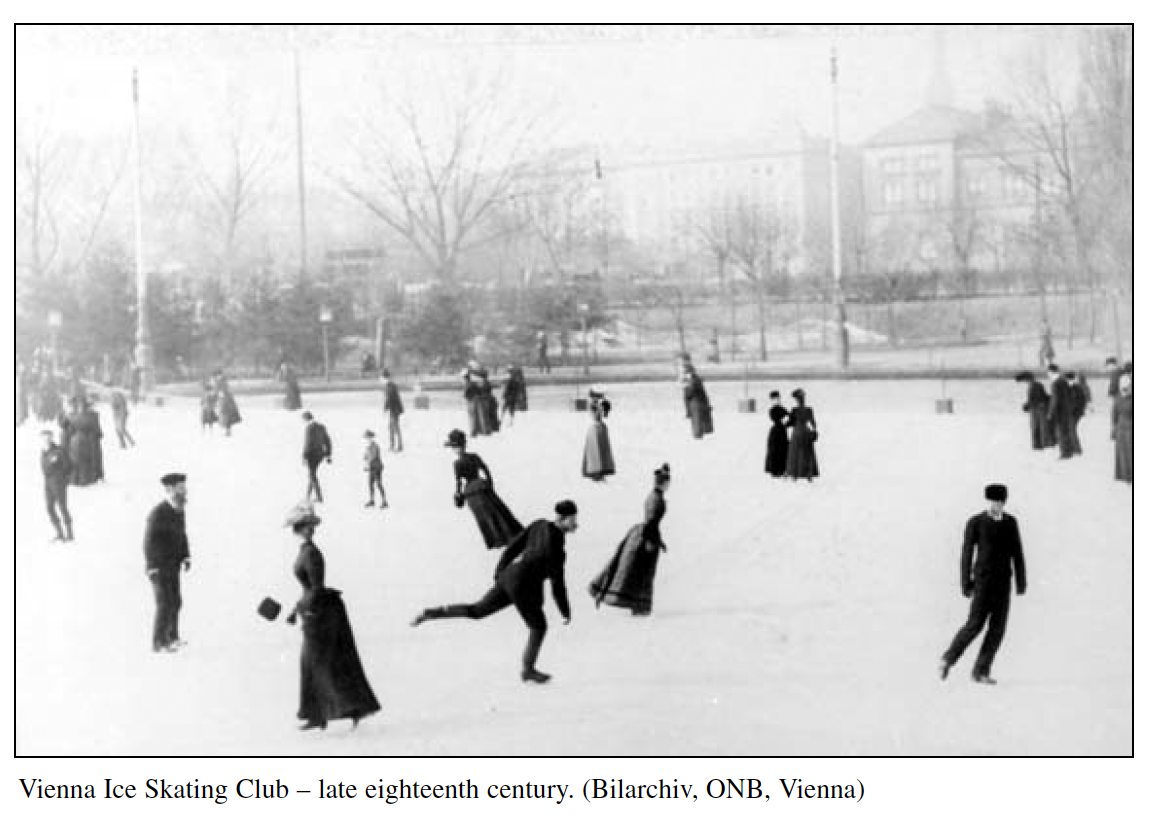
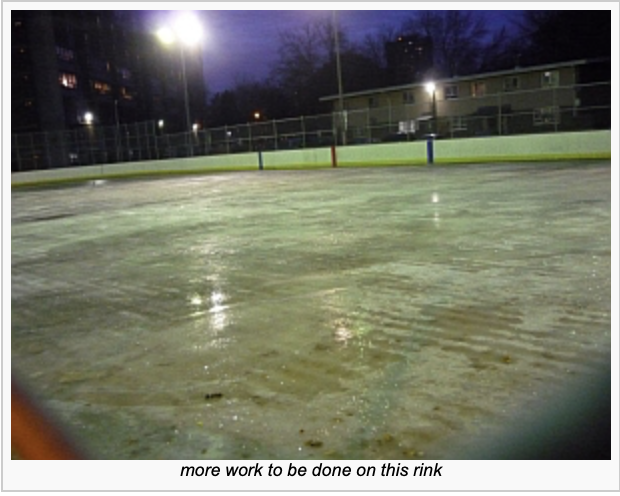
For our media component, we have attached three (very low-resolution) photos from the City Rinks archives of the Regent Park Ice Rink over the years. Taken by and for community members, these simple pictures and captions capture the importance of the rink in neighbourhood placemaking, as well as the spirit of carefreeness and quiet resistance it embodies. 

The team members of Frozen in Time are Mishika Khurana, Maddie Wintermute, Sumayyah Shahajan, and Charlotte Pink.